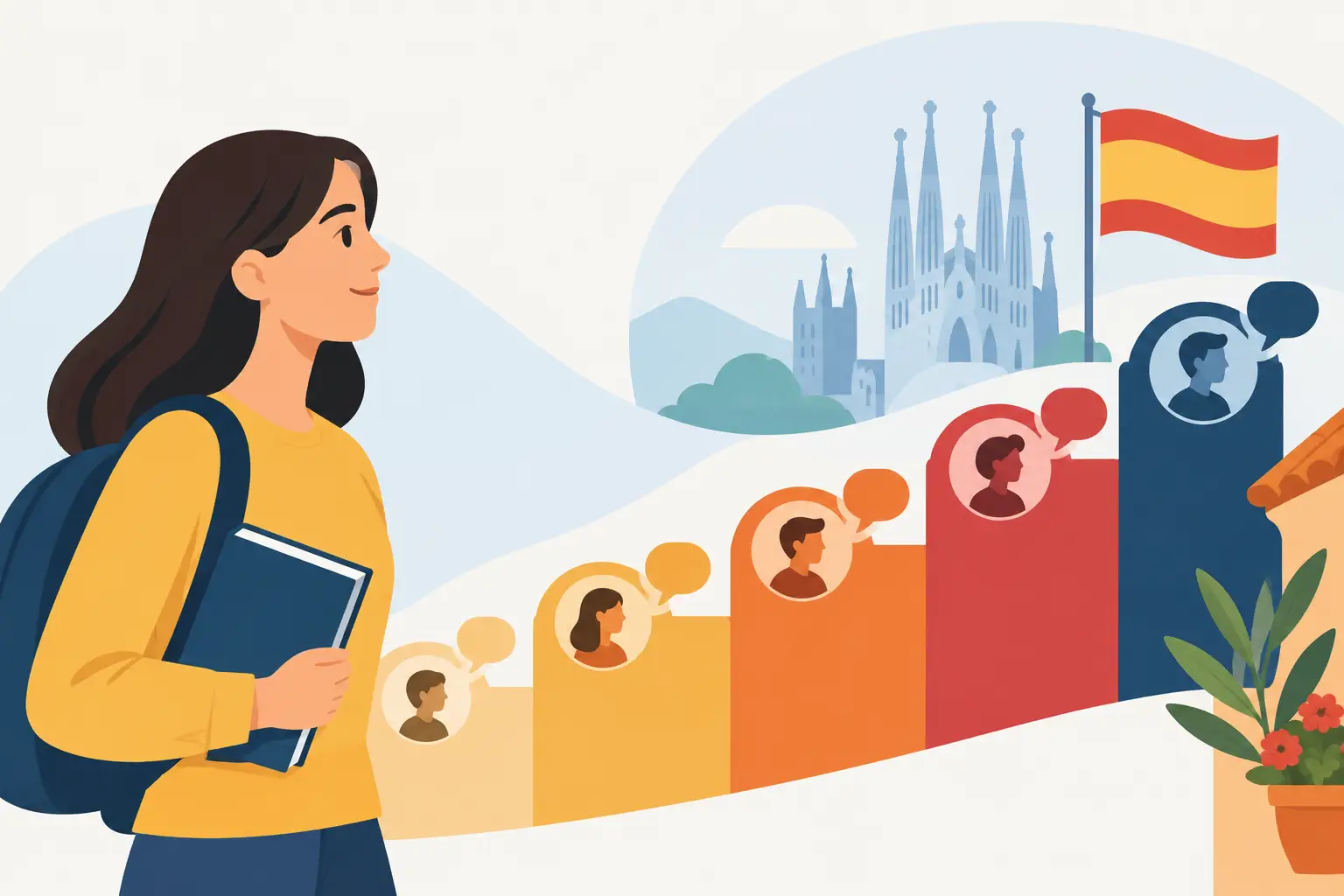
You may know how to order lunch in Spanish, introduce your family, or follow a slow conversation. But can you explain a problem at a pharmacy, understand a host parent’s story, or share what matters to you? This guide to Spanish proficiency levels helps turn those everyday moments into a clear picture of where you are and where you can grow.
Language levels are not labels that define your ability. They are helpful reference points for choosing the right kind of practice, setting a realistic goal, and recognizing progress that can otherwise be easy to miss. For many learners, the most meaningful sign of growth is not a test score. It is the first time they laugh naturally with a neighbor, help a child with homework, or take part in a conversation without translating every word in their head.
The Two Systems Behind Spanish Proficiency Levels
Most Spanish programs describe ability using the Common European Framework of Reference for Languages, or CEFR. Its six levels run from A1 to C2. In the United States, you may also see ACTFL levels: Novice, Intermediate, Advanced, Superior, and Distinguished.
The systems do not match perfectly because they measure communication in slightly different ways. Still, they point to the same big question: what can you do with Spanish in real life? A learner can know plenty of vocabulary and still feel stuck in conversation. Another learner may make frequent grammar mistakes yet communicate warmly and effectively. Both accuracy and confidence matter, and both develop over time.
For a learner planning an immersive experience, CEFR levels offer a useful map. Your starting point helps shape your classes, homestay conversations, cultural activities, and personal goals.
A Guide to Spanish Proficiency Levels From A1 to C2
A1: Beginning Spanish
At A1, you can use and understand familiar words, simple phrases, and basic questions. You may introduce yourself, say where you are from, ask for food, talk about the weather, and understand very slow, clear speech.
This level is often called survival Spanish, but it is a meaningful beginning. You are building the courage to speak before you feel ready. A week or two of focused instruction can establish helpful foundations, especially when every day gives you a reason to practice greetings, directions, meals, and simple requests.
The challenge at A1 is that conversations can feel tiring. You may understand a question but need time to form your response. That is normal. Repetition, patience, and kind conversation partners make a real difference.
A2: Elementary Spanish
At A2, everyday life starts to feel more manageable. You can discuss routines, shopping, transportation, interests, family, and familiar past events using simple language. You may still pause often, but you can usually handle predictable situations independently.
An A2 learner can gain a great deal from a homestay. Breakfast conversations, trips to the market, and questions about the day provide repeated, low-pressure practice. You are no longer only memorizing phrases. You are beginning to connect words to people, places, and memories.
Grammar remains important at this stage, particularly present and past tenses. Still, waiting until every sentence is perfect can slow you down. The goal is clear, respectful communication, then steady refinement.
B1: Intermediate Spanish
B1 is a turning point for many learners. You can manage most common travel situations, describe experiences, explain opinions, and tell stories with some detail. You may be able to follow the main point of a conversation, television program, or church service when the topic is familiar and the pace is reasonable.
At this level, you can move beyond transactions into relationships. Instead of simply asking what time dinner is, you can ask your host family about their traditions. Instead of saying you enjoyed a hike, you can describe what surprised you along the way.
B1 speakers still need support with fast speech, regional expressions, and unexpected topics. Immersion is especially valuable here because it brings those gaps into view each day. A class can clarify the grammar. A conversation on the porch gives that grammar a reason to stay with you.
B2: Upper-Intermediate Spanish
At B2, you can participate in conversations with much more ease and spontaneity. You can defend an opinion, discuss abstract topics, understand longer explanations, and follow many films, podcasts, or group conversations without needing every word repeated.
This is often the level where learners begin to feel genuinely themselves in Spanish. Humor, personality, and curiosity come through more naturally. You can contribute to a volunteer project, collaborate with coworkers, or have thoughtful conversations about culture, family, faith, education, or current events.
The trade-off is that B2 can feel less visibly dramatic than the beginner stages. You may communicate well while noticing every imperfection. Continued progress comes from precision: choosing more natural phrasing, understanding different accents, and responding flexibly when a conversation changes direction.
C1: Advanced Spanish
A C1 speaker uses Spanish effectively in academic, professional, and social settings. You can understand demanding texts, express nuanced ideas, adapt your tone to different situations, and speak at length without searching constantly for words.
This does not mean you sound exactly like a native speaker. It means language is no longer the main barrier between you and meaningful participation. You can lead a discussion, present a proposal, support a team, or build friendships that reach beyond familiar topics.
For advanced learners, the best practice is often purpose-driven. Service, professional conversations, local friendships, reading, and cultural participation develop the subtle skills that worksheets cannot fully teach.
C2: Near-Native Proficiency
C2 represents highly flexible, precise command of Spanish. You can understand almost everything you hear or read, including complex humor, idioms, and subtle differences in tone. You can express yourself fluently and accurately even in demanding settings.
Few language learners need C2 for their goals, and that is worth saying plainly. If your hope is to connect with family, travel confidently, serve a community, or use Spanish at work, B1 or B2 may already open many doors. A helpful goal is not the highest possible label. It is the level that lets you participate fully in the life you hope to live.
How to Identify Your Current Level
A placement assessment can give you a useful starting point, but your daily communication tells an equally important story. Consider what happens when a native speaker changes the subject, speaks at a natural pace, or asks you to describe something that happened last weekend. Can you respond with connected thoughts, or do you rely on individual words and memorized sentences?
Also consider your skills separately. It is common to read at B1 while speaking at A2, or to understand a host family well but struggle to write an email. This is not a failure or a contradiction. Language develops unevenly because we use each skill differently.
When setting a goal, make it concrete. Rather than saying, “I want to become fluent,” try, “I want to comfortably talk with my host family for 20 minutes,” or “I want to explain my work and ask follow-up questions.” Those goals tell you what practice you need.
Why Immersion Changes the Path
A textbook can teach you how to form the past tense. Immersion asks you to use it when you describe the waterfall you visited, the meal you helped prepare, or the person you met on a service project. That repeated connection between language and life helps Spanish become more available when you need it.
At Christian Immersion Spanish Academy, learners can build that connection through personalized instruction alongside homestays, cultural experiences, and a welcoming community in Costa Rica. Families, individual adults, and groups may arrive with very different starting points, but each can learn through the same essential rhythm: study, listen, try, make mistakes, and return to the conversation.
Progress also depends on the length and purpose of your stay. A one-week experience can strengthen confidence and establish a habit. A longer program gives you time to move through the uncomfortable middle, when you understand more than you can say, toward more natural conversation. Neither choice is better in every situation. The right one fits your season, goals, and willingness to use Spanish beyond the classroom.
Wherever you begin, let your next conversation be your measure of progress. Ask one more question, tell one fuller story, and stay present long enough for Spanish to become a bridge to another person.




Leave a Reply